A business owner paid for a logo, got an email with a PNG attached, and thought that was the deliverable. Two years later she needed it embroidered on shirts and screen printed on a banner, and the shop asked for a vector file. She did not have one. The designer had moved on and would not respond.
She paid twice for the same logo. That is a common story and it is entirely avoidable if you know what to ask for before you pay.
The file formats, and what each one is for
This is the part that causes the most trouble, so it is worth understanding rather than just requesting.
There are two fundamentally different kinds of image file. Raster files are made of pixels. Enlarge one and it gets blurry. JPG, PNG, and GIF are raster. Vector files are made of mathematical paths. They scale to any size with no quality loss, from a business card to the side of a building.
Your logo must exist as a vector. Everything else derives from it.
The vector master files:
- AI or EPS, the editable source. This is the actual logo. Whoever holds this can modify it. If you get nothing else from this article, get this file.
- SVG, the web vector format. Scales cleanly on screens and is what a developer will want for your website.
- PDF, which most printers accept and which anyone can open to see what they are getting.
The raster exports:
- PNG with a transparent background, in a few sizes. This is your day-to-day file for slides, documents, and anything placed over a colored background.
- JPG, useful for platforms that reject PNG. Note that JPG cannot hold transparency, so it always has a background.
If a designer hands you only PNGs and JPGs, you have exports without a master. That is the equivalent of receiving photographs of a document instead of the document.
The versions you need beyond the main logo
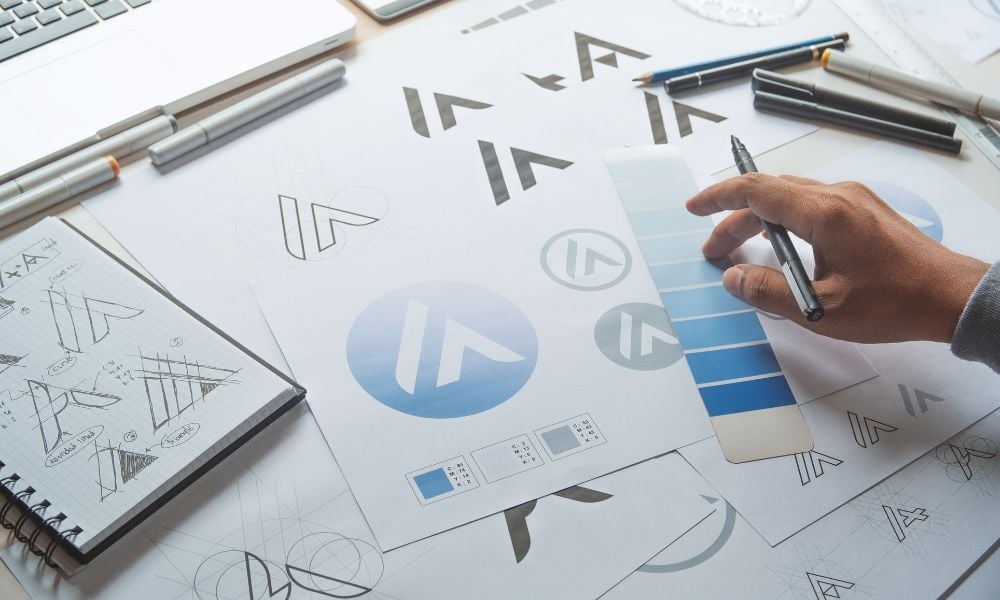
One lockup is not enough for real-world use. A complete delivery includes variations, because your logo has to work in situations the primary version does not handle.
Orientation. A horizontal version for website headers and email signatures, and a stacked or vertical version for square spaces and social profiles. A wide logo squeezed into a circular profile picture is unreadable, which is why so many businesses have an illegible avatar.
The mark on its own. Just the symbol without the wordmark, for favicons, app icons, social avatars, and small applications.
Color variations. Full color, all-black, all-white or reversed, and a single-color version. The reversed version matters more than people expect, because a logo that only exists in dark navy is unusable on a dark background, and a one-color version is what embroidery and some printing processes require.
Color modes. RGB for screens, CMYK for printing, and Pantone spot colors if you will ever do brand-critical printing. The same logo looks different in each mode, and a file prepared in the wrong one produces a print job that does not match your website.
The documentation
Files without instructions produce inconsistent use. Someone in your office will eventually stretch the logo, recolor it, or put it on a background where it disappears.
At minimum you should receive a short usage document covering:
- Color values written out: HEX for web, RGB, CMYK, and Pantone where applicable. Not described as “our blue.”
- Clear space, the minimum margin around the logo, expressed as a proportion of the logo itself.
- Minimum size, below which the mark stops being legible.
- Which version to use where, and on which background colors.
- What not to do: stretching, rotating, recoloring, adding effects, placing on busy photography.
- Typography, the typefaces used in the logo and the ones recommended alongside it, with names and weights.
For a small business, this can be four pages. It does not need to be a fifty-page brand book. It needs to exist so that the person making your next flyer is not guessing.
The font question, which trips people up
A logo built from a typeface carries a licensing question, and it is worth resolving at delivery rather than later.
Most professional logos have the lettering converted to outlines, meaning the letters become vector shapes and the font is no longer required to open or use the file. That is the correct approach and it removes the issue for the logo itself.
The separate question is your brand typefaces for everything else: your website, your documents, your signage. Those are licensed products with terms. Ask which fonts were specified, whether you hold the licenses or the designer does, and what the license covers. Web use, print use, and app embedding are often licensed separately.
This is not theoretical. Font licensing enforcement is real and businesses do receive demands over it.
Who owns it
The part most people assume is settled and often is not.
Paying someone to create a logo does not automatically transfer copyright in US law. When an independent contractor creates the work, ownership generally stays with the creator unless there is a written agreement assigning it. A verbal understanding or an invoice marked paid is not an assignment.
What you want is a written transfer of all right, title, and interest in the final logo. Watch for language granting you a license instead, which can restrict how you modify or use it, and for agreements where the designer retains rights to the concepts that were not selected.
Also settle portfolio use in advance. Most designers reasonably want to show the work, which is usually fine. Agree it rather than discovering it.
We wrote more about this in our piece on what to look for in a marketing agency contract, and it applies to a single logo project just as much as to a retainer.
A delivery checklist
Print this and check it against what you received.
- Editable vector master: AI or EPS.
- SVG for web use.
- PDF for print vendors.
- Transparent PNGs in several sizes.
- Horizontal and stacked versions.
- Icon or mark on its own.
- Full color, one color, black, and reversed versions.
- RGB and CMYK versions, plus Pantone if relevant.
- Written color values in HEX, RGB, CMYK, and Pantone.
- A usage document covering clear space, minimum size, and misuse.
- Typeface names and licensing status.
- A favicon file for your website.
- Correctly sized social profile images.
- Written assignment of ownership.
Fourteen items. A designer who delivers all of them has done the job. One who delivers three has not, whatever the file looked like.
What to do if you are already missing the master
First, ask. Designers and agencies frequently still have the file and will send it on a polite request. Be specific about wanting the editable vector source, not another export.
If the original designer is unreachable, the logo can be redrawn as a vector from a high-resolution raster image. It is a real cost but a modest one compared to a redesign, and a competent designer can match the original closely. You will want to confirm you have the right to have it redrawn, which loops back to the ownership question above.
The one thing not to do is carry on using a PNG and hope it never comes up. It always comes up, usually the week you need something printed.
We deliver the full set on every identity project, including source files, and you own all of it outright. If you are not sure what you currently have, send us your logo files and we will tell you what is missing.
More from Design Thumbprint

Why Your Emails Are Going to Spam: SPF, DKIM, and DMARC
Emails landing in spam is almost never a content problem. It is a DNS problem, and the inbox providers stopped being forgiving about it. SPF, DKIM, and DMARC in plain language.

How Insurance Agents Build a Referral Engine That Doesn’t Depend on Price
Price-won insurance business is rented, not owned. How to build a referral system around the five moments that actually generate them, and the anti-rebating rules you have to build it inside.

What Is llms.txt and Does Your Business Actually Need One?
llms.txt gets described as the new robots.txt, which is not accurate. What it actually does, who genuinely reads it, and an honest test for whether your business needs one.
Want this kind of thinking applied to your marketing?
We are a boutique agency in Edmond working with businesses across Oklahoma and beyond. If something here raised a question about your own marketing, ask us directly.
- Call
- 405-766-6169
- info@designthumbprint.com