
Restaurant marketing advice tends to skip straight to social media. Post the special, film the kitchen, chase the algorithm. All of that has its place, but it is not what decides whether you show up when somebody two miles away types “best tacos near me” at 6:40 on a Friday.
That search is decided by your Google Business Profile and the signals feeding it. And three of the strongest signals are things most restaurants treat as housekeeping: the menu, the photos, and the reviews.
Why restaurant search is its own animal
Most local businesses get found through a handful of service queries. Restaurants get found through an enormous and messy vocabulary. Cuisine type, dish name, occasion, dietary restriction, time of day, vibe. “Patio brunch,” “gluten free pizza,” “quiet place for a business lunch,” “birria,” “open late.”
Google is matching all of that against whatever text it can find about you. If the only text it has is your category and a two-sentence description, you are eligible for a fraction of the searches you could be winning. Everything below is really about giving Google more accurate material to match against.
Your menu is content, not a PDF
This is the most common and most expensive mistake in restaurant websites. The menu is a PDF, or worse, a flat image of a designed menu. It looks exactly like the printed version, which feels like a win, and it is nearly invisible to search.
An image-based menu means Google cannot reliably read a single dish name. Every item you serve, every ingredient, every descriptor that someone might search for, all of it sits in a format the search engine has to guess at. A PDF is marginally better and still bad, because it loads slowly, reads terribly on a phone, and rarely gets indexed as a real page.
The fix is not complicated. Publish the menu as actual text on an actual web page. Sections as headings, dish names as headings or bold text, descriptions as readable copy underneath. Keep prices current. If you want the beautifully designed version too, offer it as a download alongside the real page rather than instead of it.
Two things follow from this that are worth doing while you are in there. Add your menu to your Google Business Profile as well, not just your site. And add structured data so search engines can parse the restaurant details explicitly rather than inferring them. Google’s local business structured data documentation covers the markup for hours, price range, cuisine, and menu location.
Descriptions matter more than owners expect. “Carnitas Tacos” is a dish name. “Carnitas Tacos, slow-braised pork shoulder, white onion, cilantro, salsa verde, corn tortillas” is a dish name plus six more things a person might be searching for. Write the menu for a hungry stranger, not for a regular who already knows.
Photos are a ranking signal and a conversion signal at the same time
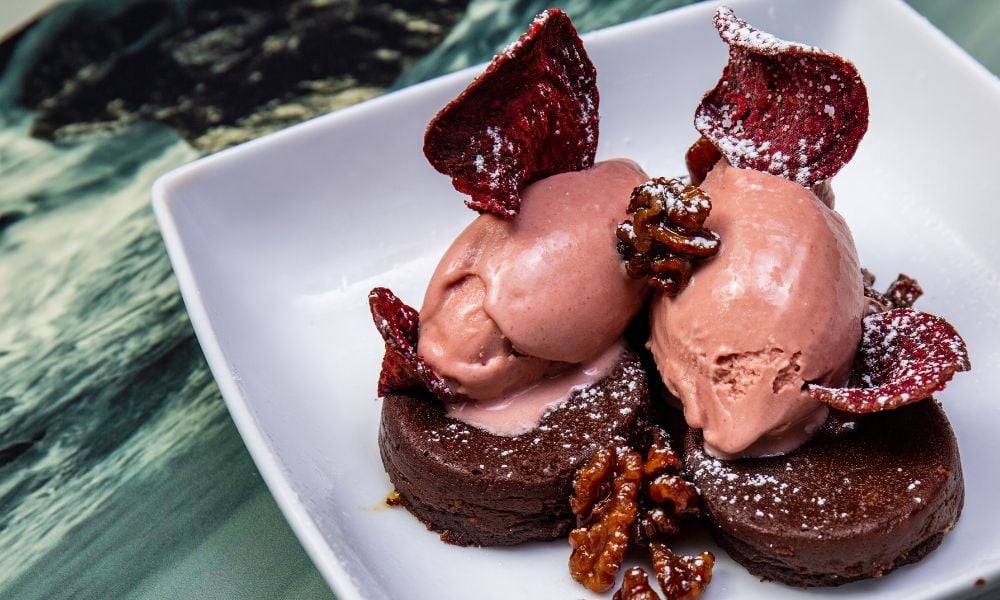
Google explicitly names prominence, which includes engagement and activity, as a local ranking factor. Photos drive engagement on your profile more than almost anything else, and a profile whose newest photo is from 2022 reads as a business that may not still exist.
But the ranking piece is only half of it. In restaurant search, photos do the closing. Someone comparing three listings makes a decision in about four seconds based on what the food looks like. If your competitor has forty sharp, well-lit plate shots and you have eleven customer photos taken under a heat lamp, the ranking barely matters.
A few things that consistently separate good restaurant photography from filler:
- Shoot the actual menu, not a sampler. Your top fifteen sellers, each one photographed properly. These are the dishes people are deciding between.
- Include the room. Interior shots answer a question people are genuinely asking: is this the kind of place I am looking for tonight? Patio, bar, dining room, private space.
- Use natural light where you can. The single biggest difference between professional food photos and phone photos is usually the light, not the camera.
- Keep adding them. A steady trickle of new photos outperforms one big upload and then two years of nothing.
- Name and tag your files. Descriptive filenames and alt text on your website give search engines readable context for images they cannot otherwise interpret.
This is the kind of work we handle through our commercial and food photography service, and you can see examples of the food and drink work in our photography gallery.
Reviews: the text matters more than the stars
Every restaurant owner watches the star average. Fewer pay attention to what the reviews actually say, and that is where a lot of ranking value sits.
Review text is content Google reads. A body of reviews that repeatedly mentions brisket, patio, live music, and late hours tells Google something specific about what you are. A body of reviews that says “great food, will be back” forty times tells it almost nothing. You cannot dictate what people write, but you can influence it by what you ask. “How was everything?” produces generic reviews. “What did you order?” produces reviews with dish names in them.
A few operational notes that hold up across every restaurant we have worked with:
Respond to all of them. Good reviews get a short, specific thank you that names the dish they mentioned. Bad reviews get a calm, non-defensive reply and an invitation to take it offline. The reply is not really for the reviewer. It is for the next forty people reading.
Recency is weighted. Two hundred reviews from 2019 do less for you than thirty from the last six months. Review generation has to be an ongoing habit built into service, usually through a receipt link or a QR code, not a campaign you run once.
Never buy them. Beyond the obvious ethics, review platforms are aggressive about detection and the cost of getting caught is far higher than any benefit.
Watch the whole ecosystem. Google carries the most weight for search, but Yelp feeds Apple Maps, and inconsistent information across platforms creates the same confidence problem that inconsistent addresses do.
The things that do not move rankings as much as people think
A few honest notes, because restaurant marketing is full of expensive distractions.
Posting frequency on Instagram does not directly affect your Google ranking. It affects reach, brand, and repeat visits, all of which matter, but it is not a local search lever and should not be sold to you as one.
Paid placements on third-party directories buy visibility on that directory. They do not buy ranking on Google.
Blogging about food trends is rarely worth it for a single-location restaurant. Your search opportunity is almost entirely local and menu-driven. Time spent writing better menu descriptions beats time spent on a blog post about the history of sourdough.
A sensible order to work through it
- Get the menu onto a real, text-based web page with full descriptions and current prices.
- Audit the Google Business Profile: categories, attributes, hours including holidays, ordering and reservation links, menu link.
- Shoot the top dishes and the room properly, then commit to adding photos monthly.
- Build review requests into the end of service so they happen without anyone remembering.
- Add structured data to the site so search engines are reading your details rather than guessing.
None of it is glamorous. All of it compounds.
If you would rather have it handled, that is what our restaurant marketing and SEO work covers, and it pairs with social media management when the brand side needs attention too. Reach out and we will start with a look at how your menu and profile are currently being read.
More from Design Thumbprint

AI Prompts That Are Actually Useful for a Small Business
AI is good at a specific set of tasks that eat time and produce no differentiation, and bad at the ones that decide whether marketing works. Prompts that produce something usable, and where it reliably fails.

From Brand Strategy to Execution: How Design Thumbprint Helps Businesses Stand Out
In today’s crowded marketplace, standing out isn’t easy. Customers are bombarded with thousands of brand…

How an Oklahoma City Accounting Firm Grew Revenue 120% and Built a 40-Lead Monthly Pipeline
Most accounting firms grow the same way. Good work leads to referrals, referrals lead to…
Want this kind of thinking applied to your marketing?
We are a boutique agency in Edmond working with businesses across Oklahoma and beyond. If something here raised a question about your own marketing, ask us directly.
- Call
- 405-766-6169
- info@designthumbprint.com