
Depending on who is selling it to you, the new discipline is called AEO, GEO, LLMO, AI SEO, or answer engine optimization. The acronyms are mostly marketing. Underneath them sits a real change worth understanding, and it is smaller than the pitch decks suggest and more consequential than the skeptics admit.
The useful question is not whether SEO is dead. It is which parts of your strategy actually behave differently when a machine answers the question before anyone reaches your site.
Sorting the terminology
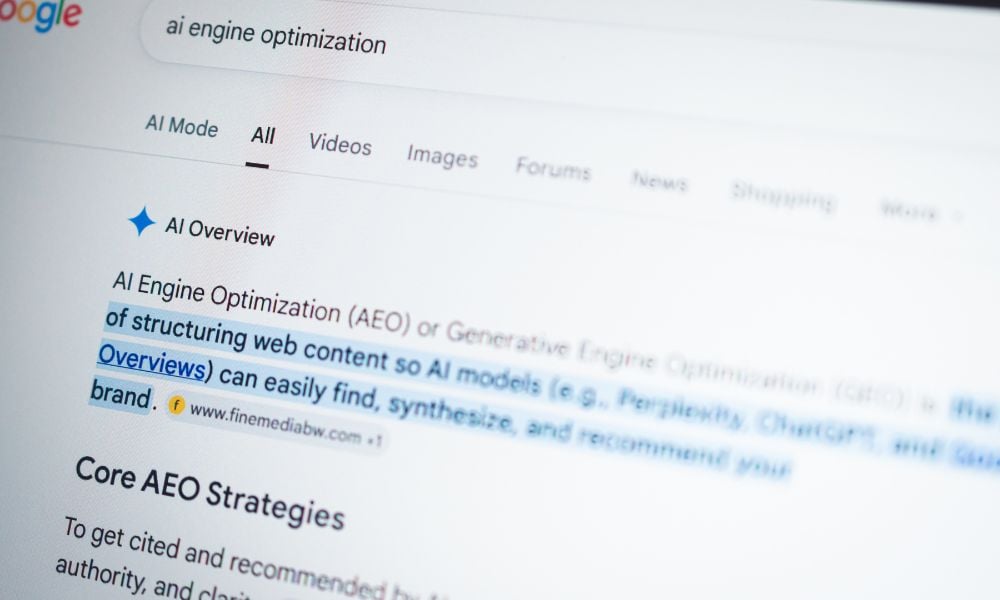
AEO generally means optimizing to be the answer rather than a link. GEO, generative engine optimization, means roughly the same thing with a different prefix. LLMO and AI SEO are the same idea again.
None of them describe a separate technical discipline. They describe a shift in emphasis within search optimization, which is why almost every practical AEO recommendation turns out to be an SEO recommendation with the priorities reordered. Anyone presenting it as a wholly new practice requiring a wholly new budget line is selling a framing, not a service.
That said, four things genuinely change.
What actually changes
1. Traffic composition, not just traffic volume
The obvious effect is fewer clicks on informational queries. Someone asking what a title company does, or how long a roof lasts, or whether they need an LLC now gets an answer without visiting anyone.
The less obvious effect is what that does to the traffic you keep. The visitors who still arrive have generally moved further down the decision. They read the summary, they have a shortlist, and now they want specifics about you. Several analyses have reported that AI-referred visitors convert at notably higher rates than standard organic, though the figures vary widely by source and should be treated as directional.
The strategic consequence: a page that exists to capture informational traffic and funnel it slowly toward a decision is a weaker asset than it used to be. A page that answers the specific, comparative, late-stage question is a stronger one.
2. Visibility without attribution
This is the change most businesses have not adjusted to. AI engines mention brands considerably more often than they link to them. Your business can be recommended by name in thousands of conversations and generate no measurable referral, no impression in your reporting, and no evidence in any dashboard you own.
That breaks the basic assumption behind a decade of digital marketing measurement, which is that visibility produces a trackable visit. Increasingly it does not. Someone can hear your name from an AI engine, remember it, and search for you directly three days later. In your analytics that is direct traffic with no origin.
3. Measurement gets genuinely harder
Follow from the above. Your existing tools were not built for this.
Search Console does not separate AI Overview impressions into their own reporting line, so a drop in click-through rate at stable impressions is ambiguous. It could mean AI is absorbing the click, or it could mean your title tag got worse.
There are three things you can actually do.
Watch referral sources in analytics. Traffic from chatgpt.com, perplexity.ai, and similar domains shows up as referral traffic. It is usually small in volume and worth segmenting out separately, because its behavior on site looks different from ordinary organic.
Track click-through rate by query type over time. Informational queries losing CTR while commercial and branded queries hold steady is the signature of AI absorbing top-of-funnel clicks. That is a rebalancing signal, not necessarily a problem.
Test manually and write it down. Pick the fifteen questions a prospect would ask. Run them across the major engines. Record whether you appear and who appears instead. Repeat quarterly. This is unglamorous and it is currently more reliable than most paid tools at the scale a local or regional business operates at.
4. Content structure matters more than content volume
The old incentive rewarded comprehensiveness. Longer pages covering every angle tended to rank.
The new incentive rewards extractability. A retrieval system is looking for a self-contained passage that fully answers one question. A 4,000-word page with the answer buried in paragraph nine is less useful to it than a clear 300-word section under a question-shaped heading.
The practical translation is that reformatting your existing pages usually returns more than publishing new ones. We went through the specific tactics in our piece on getting cited by AI engines.
What does not change
This is the part that gets lost, and it is most of the work.
Crawlability. Nothing can cite a page it cannot reach. Site speed, clean structure, functioning internal links, an accurate sitemap.
Entity clarity. Consistent name, address, phone, and service descriptions everywhere. If anything, this matters more now, because these systems are trying to establish that you are a specific real organization before they will name you.
Authority and credibility. Earned mentions, real reviews, genuine expertise. The mechanism is somewhat different but the underlying requirement is identical.
Local fundamentals. For a business serving a geography, the Google Business Profile remains the single most important asset, for AI answers as much as for the map pack.
Actually answering the question. Content written for search engines rather than people performed badly before and performs worse now.
Google has been consistent that its AI surfaces rely on ordinary search signals rather than special markup, and its Search Essentials remain the operative guidance. That is a boring position and the evidence supports it.
How to think about budget
The honest allocation for most businesses is not a new AEO line item. It is a reweighting of the existing one.
Spend less on broad informational content designed to capture top-of-funnel traffic. That traffic is being absorbed and it was never the traffic that converted anyway.
Spend more on restructuring existing pages for direct answers, building a real FAQ from the questions your phone actually receives, earning third-party mentions, and generating reviews.
Keep spending on technical health, Business Profile management, and the service pages that convert. These carry across every surface.
Do not spend on anything promising to place your brand inside a model’s training data, or on tooling before you have established a manual baseline.
The part nobody enjoys hearing
If your search fundamentals are weak, AI search does not present you with a new opportunity to leapfrog competitors. It presents you with the same problem, harder. These systems draw on the same signals of clarity, consistency, and credibility that traditional search does, so a business that is invisible in one tends to be invisible in the other.
The businesses getting cited are, overwhelmingly, the ones that did the ordinary work. There is no shortcut being sold here that outperforms a complete Business Profile, eighty recent reviews, and a website that answers questions clearly.
What is genuinely new is the measurement problem and the shift in what content is worth producing. Those are real, they deserve attention, and they do not require abandoning anything that was working.
We handle SEO and local search for businesses across Oklahoma and we will tell you plainly which of this applies to you and which does not. If you want a straight read on where you stand across both traditional and AI search, get in touch.
More from Design Thumbprint

The Power of Social Media Marketing: How to Build Engagement and Grow Your Brand
Social media has transformed how businesses connect with their customers. What started as a way…

How Plumbers Generate Leads and Keep the Calendar Full
Plumbing demand arrives in two patterns that need different channels, budgets, and measurement. How to run emergency and scheduled work as separate motions, and how to prepare for a freeze event.

The Complete Guide to Digital Marketing for Small Businesses
In today’s competitive market, having a great product or service is only half the battle.…
Want this kind of thinking applied to your marketing?
We are a boutique agency in Edmond working with businesses across Oklahoma and beyond. If something here raised a question about your own marketing, ask us directly.
- Call
- 405-766-6169
- info@designthumbprint.com